1. Where the Game Is Today
Cricket stands at a critical juncture.
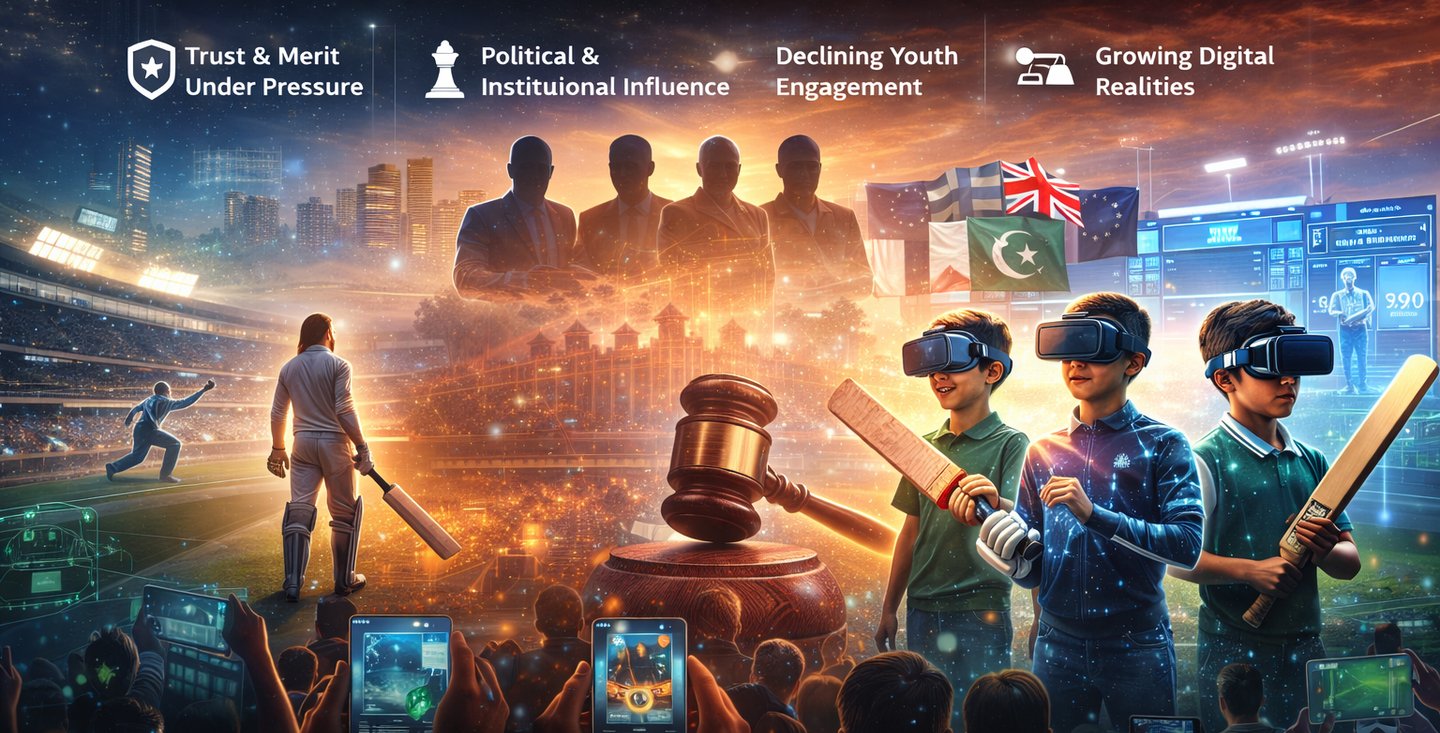
Across multiple cricketing nations, long-standing systems of selection, development, and opportunity are under increasing strain. While these structures historically provided stability and governance, the modern era has introduced new pressures: rapid technological advancement, heightened fan intelligence, expanding commercial interests, and increased political and institutional influence within sporting environments.
As decision-making has become more centralized and less transparent, perceptions of fairness, merit, and independence have increasingly been challenged. At the same time, younger generations—who engage with sport through digital ecosystems and expect openness, accountability, and participation—are becoming progressively disconnected from traditional pathways and institutions.
Together, these developments present not only operational challenges, but long-term risks to trust, participation, and the continued relevance of the game.
2. The Emerging Risk
If cricket does not adapt proactively, several risks become increasingly likely:
Gradual erosion of public trust in selection and governance processes
Declining engagement from younger audiences
Growth of informal, unregulated digital cricket ecosystems outside institutional oversight
Increased polarization between fans, players, and governing bodies
These risks do not emerge abruptly; they accumulate quietly over time. Addressing them requires evolution rather than disruption.
3. The Inevitable Shift
Technology is already reshaping global sport.
Data-driven performance analysis, digital fan participation models, virtual sporting environments, and transparency expectations are now standard across multiple industries. Cricket is not exempt from these forces.
The strategic question facing the global game is no longer whether technology and fan intelligence will influence cricket—but how responsibly, transparently, and constructively they are integrated within existing governance frameworks.
4. The Digital Cricket Framework
Digital Cricket is proposed as a governance-support framework, not a competing authority.
Its core principles are:
Coexistence with existing cricket boards and selectors
Phased implementation, starting small and remaining reversible
Transparency and merit, supported by data and structured fan input
Institutional alignment, not institutional replacement
The framework is designed to strengthen existing systems by introducing controlled, accountable mechanisms that increase trust and engagement without destabilizing governance.
5. A Measured Starting Point
Rather than immediate systemic change, Digital Cricket proposes a limited, cooperative entry point.
An initial phase could allow structured fan participation in the selection of a small number of national players, operating alongside existing selection processes. This preserves institutional authority while introducing transparency, engagement, and performance-driven accountability.
Such an approach enables evaluation, refinement, and controlled scaling—rather than irreversible reform.
6. Alignment with Cricket’s Core Values
Digital Cricket aligns directly with the long-term objectives of the global game:
Merit-based opportunity
Transparency and integrity
Sustainable global growth
Youth engagement and future participation
Protection of institutional credibility
By offering a structured interface between modern digital realities and traditional governance, the framework supports cricket’s evolution without compromising its foundations.
7. Conclusion
Digital Cricket is not a call for disruption.
It is an invitation to explore how cricket’s governing institutions can evolve responsibly, protect trust, and remain relevant to future generations—while preserving the values that define the game.
The framework is intended as a collaborative concept, open to refinement, oversight, and institutional leadership.